
Loading...
Loading...
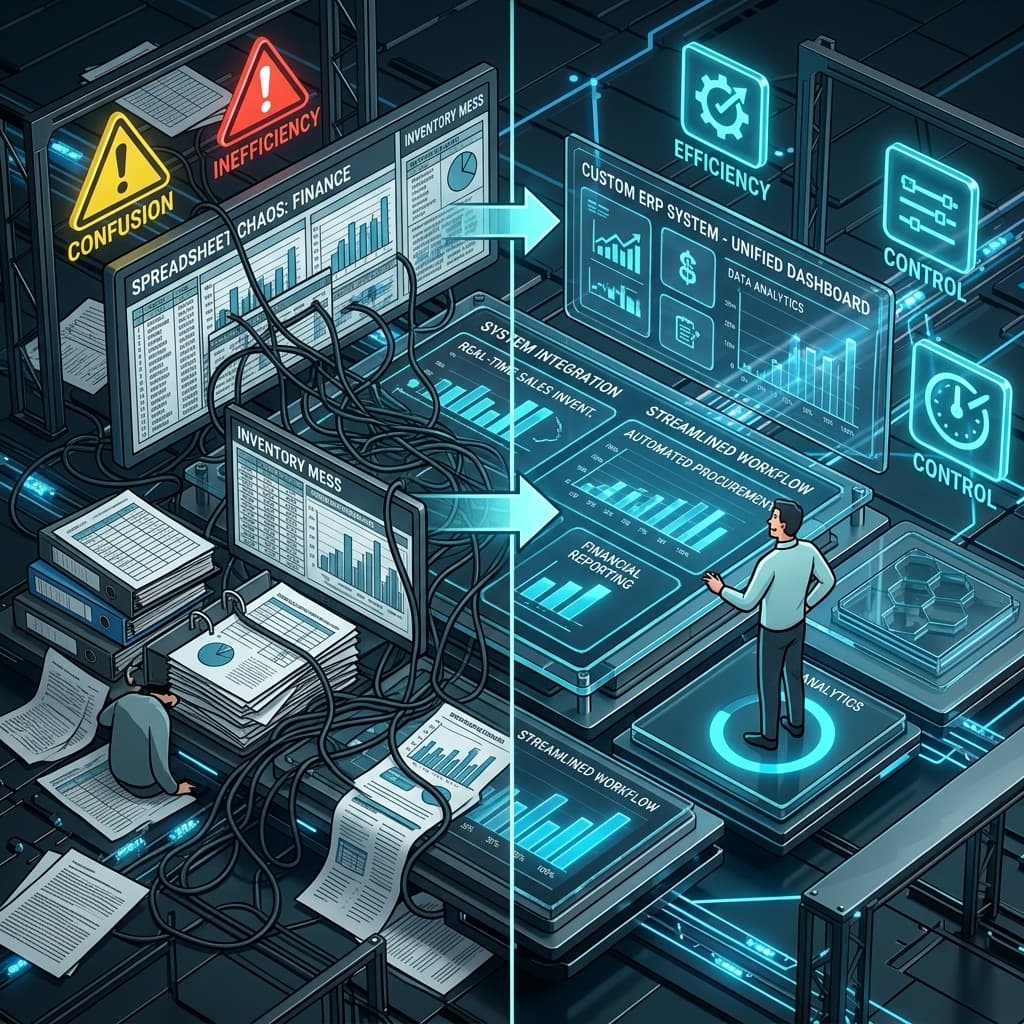
Every growing business has that moment. The moment when someone asks a simple question — 'How many units did we ship last month?' — and three people give three different answers, each pulled from a different spreadsheet. The inventory sheet says 1,240. The finance sheet says 1,185. The operations lead checks WhatsApp messages and says it's closer to 1,300. Nobody is wrong. The system is. This is the story of how one of our clients went from spreadsheet chaos to a unified ERP — and what we learned building it.
Our client was a mid-size distribution company handling 200+ SKUs across three warehouses. Their 'system' was a collection of Google Sheets, WhatsApp groups, and a shared email inbox. Orders came in via phone calls and WhatsApp. Someone would manually enter them into a sheet. Someone else would update inventory. A third person would create an invoice in Tally. By the time a month-end report was generated, the numbers never matched — because no two sheets were updated at the same time. The team had accepted this as 'just how it works.' They didn't realize how much revenue they were leaking.
Before building anything, we spent two weeks mapping their actual workflows. What we found: the team was spending roughly 14 person-hours per day on data entry that could be automated. They had written off approximately 8% of their inventory as 'discrepancies' — product that existed in sheets but not in warehouses, or vice versa. Order fulfillment errors were running at 6%, most caused by outdated stock data. And the finance team was spending the first 10 days of every month just reconciling numbers across sheets. When we calculated the annual cost of these inefficiencies, it exceeded the entire development budget for a custom ERP by 3x.
They had tried. They evaluated Zoho Inventory, ERPNext, and a local Tally-based solution. Each one failed for the same reason: their business didn't operate the way the software assumed. Their pricing model was relationship-based — different rates for different dealers, with seasonal adjustments and volume discounts that no template could handle. Their warehouse workflow involved a manual quality check step that no off-the-shelf system accounted for. And their sales team refused to use anything that wasn't as fast as WhatsApp. Every generic ERP required them to change how they worked. They needed software that adapted to them.
We built a custom ERP with five core modules, each designed around their actual daily operations: (1) Order Management — dealers place orders via a simple mobile interface that feeds directly into the system. No phone calls, no WhatsApp screenshots. (2) Inventory & Warehouse — real-time stock tracking across all three warehouses, with barcode scanning and the quality check step baked into the workflow. (3) Invoicing & Finance — automatic invoice generation with dealer-specific pricing, GST calculation, and direct export to their accounting software. (4) Dispatch & Logistics — route planning and delivery tracking with driver assignments and proof-of-delivery capture. (5) Dashboard & Reports — a single screen showing live KPIs: orders today, pending dispatches, stock alerts, and monthly revenue — updated in real time, not after 10 days of reconciliation.
The hardest part of any ERP migration isn't building the new system — it's transitioning without disrupting daily operations. We ran both systems in parallel for 6 weeks. During week 1-2, we migrated master data: products, dealers, pricing rules, and warehouse locations. Week 3-4 was 'shadow mode' — staff entered data in both the old sheets and the new system, so we could verify accuracy. Week 5-6 was assisted go-live: the team used only the new system, with our developers on standby for any edge cases. By week 7, the old spreadsheets were archived. Nobody missed them.
Six months after go-live, the numbers spoke for themselves. Data entry time dropped from 14 person-hours/day to under 2. Inventory discrepancies fell from 8% to under 1%. Order fulfillment errors dropped to near zero. Month-end financial closing went from 10 days to 2 days. And the management team — for the first time — had a real-time view of their business that they trusted. The CEO told us something that stuck: 'We didn't just get software. We got our weekends back.'
If your business is still running critical operations on spreadsheets, here's what we've learned from this and similar projects: First, the cost of 'doing nothing' is always higher than you think — measure it before you dismiss a custom build as expensive. Second, don't try to fit your business into software that wasn't designed for it. Third, migration doesn't have to be risky if you run parallel systems and validate data before cutting over. And finally, the best ERP is the one your team actually uses — which means it needs to be as simple and fast as the tools they're already comfortable with.
Is your team drowning in spreadsheets and manual workarounds? The Appziac team has helped businesses across manufacturing, logistics, and distribution move to custom ERP systems that actually match how they operate. Let's talk about what yours should look like.